

Morning Pages and Essay Writing
12 Steps to Get Your Essay Started

About a year ago, I stumbled onto Julia Cameron’s Morning Pages practice. I was joining the Writing Hour by the London Writing Salon, and they encouraged those of us who did not have a specific writing project to practice Morning Pages. Three pages of longhand writing about anything that comes to mind. A brain dump, if you will. I loved the idea, especially for someone who has been on again off again with my writing, more often than not feeling blocked, or bogged down by the technical writing I do at work, or and the report reviewing and action plan feedback…etc. So I started my morning pages practice, and was surprised with how much pessimism came pouring down onto the page, and how much more relaxed and focused I became, and how much more productive I have become.
Some days I only wrote about my emotions, feeing anxious, testy, stressed out. I wrote about overthinking my children’s lives, their future, what colleges they will go to. I wrote a lot about Gaza, the horrors, and how that left me feeling. And in the process some of the paragraphs turned into pieces. A few made it onto my Substack newsletter, others are still confined to my notebook pages, written in barely legible handwriting, and may never see the light of a computer screen, or the flash of a like, or comment anywhere. I figured ,maybe one day my children will read what I wrote and learn more about the woman I was as their mother. The struggle of working and mothering and wifing…etc.
Anyway, I should tell you that sometime in September as the school year started, and my family went through a difficult time, my husband’s sister passed away from cancer end of September, I fell off the writing, walking, yoga practicing wagon. And more often than not during the day, I feel my head exploding because along with all the work, there are a bunch of flying ideas that simply don’t want to shut up.
And while the work gets done, the dinner gets cooked, the homework is supervised, I am exhausted and feel a lack of clarity in my head. I also noticed that focusing in, or as I like to say hunkering down onto a report, or a narrative or even a Substack entry takes a little more effort.
Sure, I could say this is perimenopause and that my brain is changing, and I am sure that is part of it. But you and I know that it is not only that. We know that writing is thinking. Writing allows us to work through our thoughts, gain clarity. I used to say this to my students all the time, if you really want to know what you are thinking, write. I bet when you start to write you will discover thoughts you did not even expect to be there bubbling to the surface. You will for sure come up with unexpected solutions, or more in depth arguments. When you write you think, and when you think, you wade through the noise and finally get to the bottom of your ideas.
Morning pages are meant to remove all the barriers that stop us from focusing inwards, from tackling the question at hand, or the task at hand. They also may be the place where we find answers to a homework assignment, or an essay prompt, even if all we can use from what we wrote is one sentence. Morning pages is writing, and writing is thinking, meditating, reflecting…
So, dearest students struggling to respond to an essay prompt (any type of essay) or write a coherent paragraph, here is my unsolicited advice for you, especially if you are still struggling with your Theory of Knowledge prescribed title.
12 Steps to Starting Your Essay
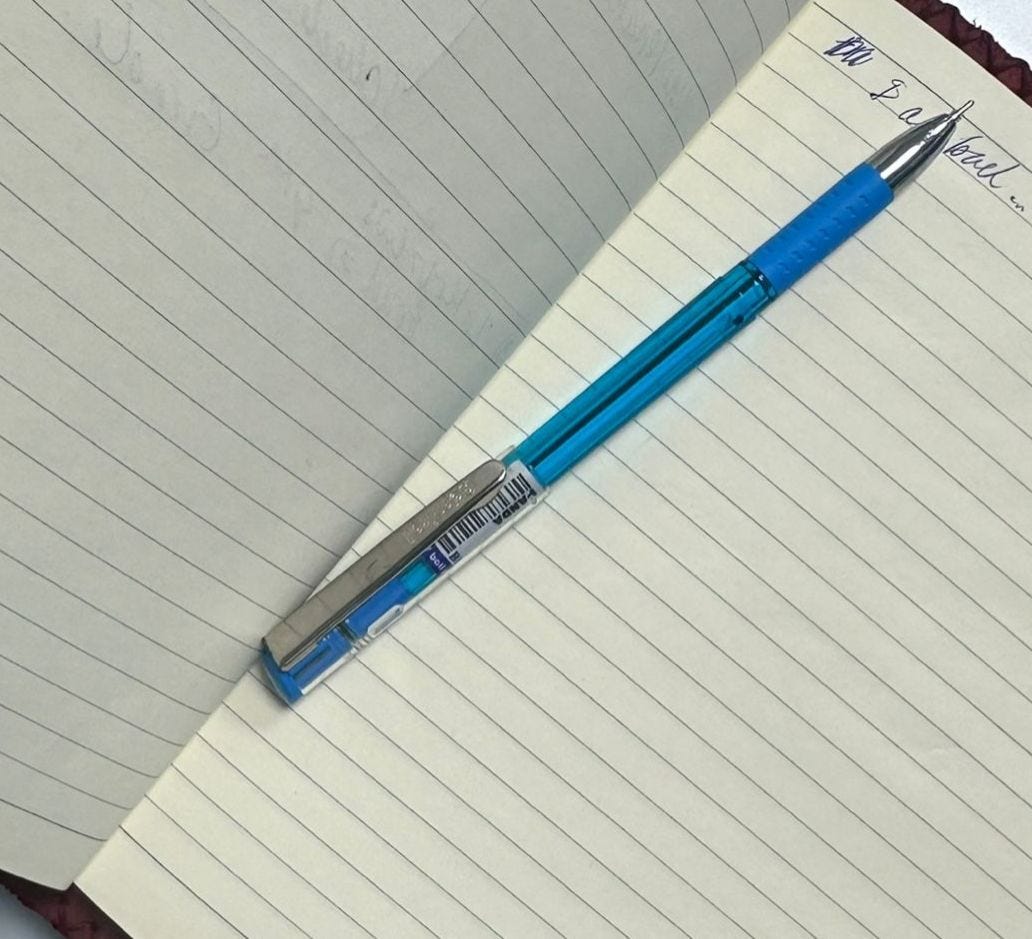
In a notebook (the kind you like the most), with your favorite type of writing pen, I like extra fine blue ball pen, write out the essay prompt/prescribed title/question, on top of the page.
Turn off your phone and laptop.
Now write…anything that comes to mind. If all you can write is I don’t understand the prompt then you write that repeatedly until the ideas start falling down. You can also write how much you don’t like TOK.
Keep writing, don’t stop your pen. The ideas will start coming. Maybe all you have is a bunch of questions about the prescribed title. It doesn’t matter just write them down.
Keep writing, don’t stop your pen. Maybe you start now by noticing the key words in the prescribed title. Write.
Don’t grab your phone! Don’t give up. The only reason we reach for our phones when we write is because we are afraid we have nothing left to say.
Stay with me, maybe now you write an answer to the prescribed title question. A short answer or a long answer. Keep writing.
Stay focused on what you are doing, even if the phone rings (you can always call whoever it is back). Keep writing.
Your minimum is three pages of handwritten work, but if you find that you are int he zone and you have started to unpack the title keep going until you are satisfied.
Read what you wrote: is there a thesis in there? are there definitions? maybe you have a claim or two, maybe even an example? Highlight everything you think you can use.
Take the time to type those ideas up. Add anything else that comes to mind as you start typing. Walk away and work on something else.
The next time you open your laptop to work on your TOK essay, you are not working from a white page. You have ideas that need to be built up. It is no longer scary. The daunting empty white page is gone. In its place are some initial ideas that can be further researched, expanded, scratched and rewritten. You are well on your way to your first draft.
Remember, this is only a 1600 word essay. Your first draft can be less than that or maybe a little above the word count (100-150 words more than the word count), not more.
Breathe, and dig back in to clean up the first draft and submit to your teacher for feedback.
When this is all over, and you are in college and later in your professional career, I hope you will use writing to workshop your ideas. And please know that writing is not easy, it is a struggle, but when it happens, it finally happens, it is magical.
I wrote this letter not for the students, but for me, to remind me to get back to morning pages, a practice that saved me through some tough times, but I also wrote it because I think that we teach writing as a product when in fact it is is a process. I also wrote this because my brain needed me to do some morning pages, and this newsletter came out when I started writing. I leave you now to your essays, or your private journaling or your morning pages, and I get back to my work, more focused and steady.
Talk to you soon.
Thank you, Riyam - I'm not a student but I definitely found this helpful! I have so many half-formed ideas for posts or non-fiction writing in general, and it just never seems to get written. I'm saving this post to remind me that it's worth doing the pages to clear some of that mental clutter and get the ideas down on paper.